

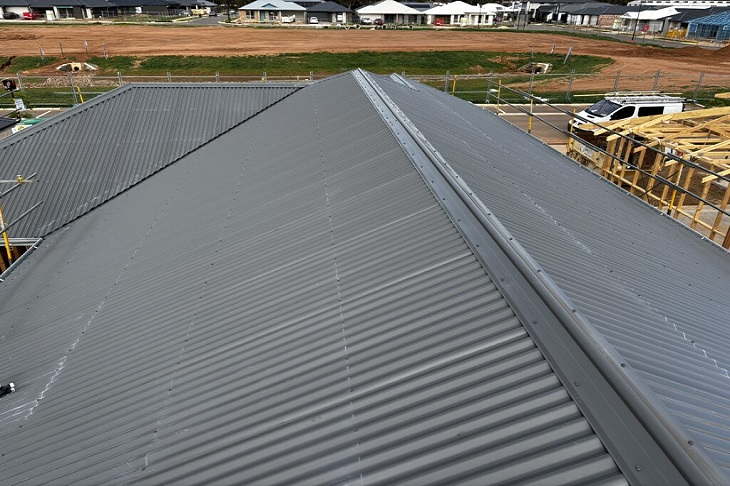
Look closely at Adelaide roofs, and one thing stands out – the ridge line. That neat row of curved or angled tiles running along the very peak of the roof isn’t just for appearances. It’s doing one of the most important jobs on the entire structure. And when it starts to fail, most homeowners have no idea until water is already inside.
So What Exactly Is Ridge Capping?
Ridge capping is the row of specially shaped tiles that sits along the highest point of a pitched roof – right where two roof slopes meet. Its job is to seal that joint completely, keeping wind, rain, and debris out while holding the roofline together.
In Adelaide, you’ll mostly see it in three materials: terracotta on older and heritage homes, concrete on homes from the 70s through to the 90s, and metal or Colorbond on more modern builds. Each behaves differently under Adelaide’s conditions – but all of them rely on two things to stay watertight: bedding and pointing.
- Bedding is the sand-cement base layer that physically anchors each ridge cap to the roof
- Pointing is the mortar or flexible compound applied over the top to seal and finish it
When either layer breaks down, the ridge cap loosens. When the ridge cap loosens, water gets in.
Why Adelaide Conditions Are Particularly Hard on Ridge Capping
Adelaide’s climate does a number on mortar. Summer heat causes expansion. Winter cold causes contraction. Repeat that cycle for ten or fifteen years and even well-installed pointing starts to crack and crumble. Add strong winds off the Gulf and the occasional fierce storm and you’ve got ridge caps that shift, lift, or separate entirely.
The Hills suburbs tend to see faster deterioration from moisture and temperature swings. Coastal areas cop salt air on top of everything else. It’s worth factoring in where your home sits when thinking about how often to get your ridge line inspected.
Signs Your Ridge Capping Needs Attention
Most of this is visible from the ground if you know what to look for:
- Cracked or crumbling mortar along the ridge line
- Tiles that look uneven, shifted, or slightly lifted
- Flakes of old mortar showing up in your gutters
- Ceiling stains after rain – especially near the top of internal walls
- Moss or lichen taking hold along the peak of the roof
Any one of these is worth getting looked at. Two or more and you’re likely already losing water into the roof structure.
Repointing vs. Rebedding – What’s the Difference?
This is where a lot of homeowners get confused, and some less scrupulous tradies take advantage.
Ridge cap repointing in Adelaide means replacing only the top mortar layer – the pointing. It’s the right fix when the bedding underneath is still structurally sound and the caps themselves are sitting securely.
Rebedding goes a step further, removing both layers and starting fresh. It’s necessary when the base has failed, the caps have shifted significantly, or the roof is older and the original bedding has completely deteriorated.
A licensed roofer should inspect and tell you honestly which one applies. If someone quotes rebedding without getting up to check, that’s a red flag.
When to Call a Professional
Always. Ridge capping sits at the highest point of your roof, which makes it genuinely dangerous to DIY – and incorrectly fixed ridge capping can cause more water damage than leaving it alone. Roof tile repairs Adelaide homeowners attempt themselves often end up costing more to correct than the original problem.
Complete Roofing handles ridge capping repairs, repointing, and rebedding across all Adelaide suburbs. Free inspection, fixed prices, honest advice on what your roof actually needs. Call us before the next storm makes the decision for you.